Airbus Aircrafts are Getting a ‘Shark Skin’ Finish
By Jörg Schurig (text) and Katharina Kausche (photos), dpa
WAGS meets WATCH
In the 1970s, researchers discovered the “riblet” effect of shark skin. It minimises drag and makes the animals incredibly fast. A perfect opportunity for technology.
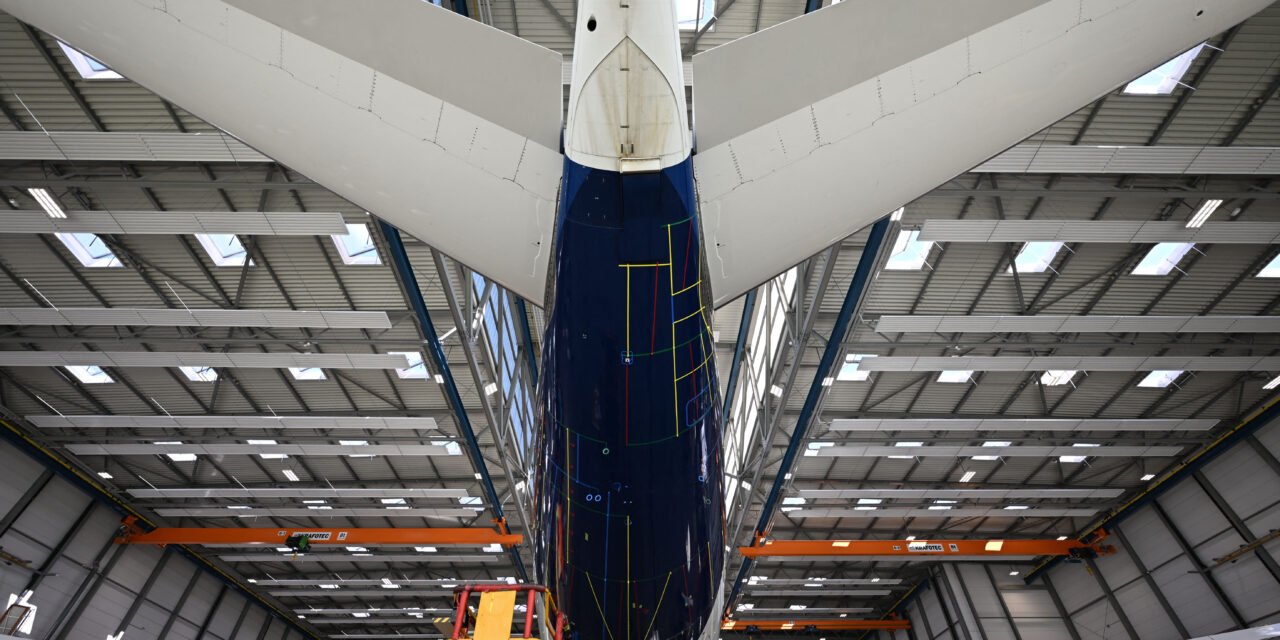
Dresden (dpa): Sharks not only have sharp teeth, but also a special skin. This makes them fast predators of the seas and a model for technology. Following the first Boeing jets, Airbus aircraft are now also set to fly with artificial sharkskin. The world’s first “AeroSHARK” installation on an Airbus A330 is currently being carried out at the Elbe Flugzeugwerke (Elbe Aircraft Works) in Dresden. The test aircraft belongs to Lufthansa’s leisure airline, Discover Airlines.
Behind “AeroSHARK” lies a technology that mimics the advantages of shark skin on an ultra-thin film. These advantages have been known to science since the 1970s. Shark skin is covered with tiny scales that, like microstructures, can reduce drag and increase flow efficiency, explains the Fraunhofer Institute for Manufacturing Technology and Advanced Materials.
Microscopic Grooves on the Shark’s Skin
Microscopic, parallel grooves run along the surface of the skin, breaking up water turbulence and channeling the water practically around the body, thus reducing frictional resistance. This also helps to keep out dirt and parasites.
The AeroSHARK Riblet technology, developed by Lufthansa Technik AG and Surventis (formerly BASF Coatings), also utilises these advantages. The eponymous film is designed to reduce air resistance and thus lower fuel consumption and CO2 emissions. The process is currently certified for several variants of the Boeing 777. The Airbus A330, the second most frequently delivered long-haul aircraft type, is now slated to follow.
In the Future, Wings and Tail assembly will Also Receive Foil Coverings
Lufthansa Technik AG says it plans to expand the program to other models and additional aircraft surfaces. Currently, the films are only applied to the fuselage and engine nacelles, but the focus is also shifting to the wings and tail assembly.
“They are the aircraft’s most important lift-generating elements. This means we are making significant interventions in the aerodynamics,” explains Soenke Burger, responsible for “AeroSHARK” development at Lufthansa Technik. The aircraft’s overall controllability, in turn, depends on this.
The “shark skin” coating on the aircraft is quite intricate. The grooved structure is only 50 micrometers deep, half the thickness of a human hair. The films measure one meter by 50 centimeters. Applying them bubble-free to the meticulously cleaned fuselage is no easy feat. Anyone who has ever tried to wrap a soccer ball in plastic film can imagine how difficult it is, says Burger. A good 880 square meters of the A330 will be covered, a process that is expected to take ten days.
The Long-Term Goal is to Save Two Percent on Fuel Consumption
The optimised surface is expected to save aircraft 1 to 1.2 percent on fuel. According to Burger, the cost-of-weight effect also plays a role. A heavier aircraft leads to higher fuel consumption. If less kerosene is used, less needs to be carried. Should the wings and tail assembly later also be covered with a film, a saving of about two percent could be achieved. Even at one percent, a long-haul aircraft could save almost a ton of kerosene per day.
Simply applying the film isn’t enough. Since air traffic demands the highest level of safety, the certification process follows a strict regime. First, additional measuring equipment was installed on the Discover Airlines A330.
“We begin by conducting test flights and analysing the flight behaviour in great detail,” explained Johannes Helldorff, who oversees the application of the film for Lufthansa Technik. The goal is to compare the aircraft before and after the film is applied. How does the aircraft behave in the air without the film, and how does it behave with it?
Noticeable Cost Savings and CO2 Reduction
“If the technology is used in a global fleet, it will enable noticeable cost savings and make an important contribution to more sustainable aviation,” says Lufthansa Technik.
This year, the company entered into a collaboration with Airbus to develop and certify the application of AeroSHARK Riblet technology to the wings and tail surfaces of the Airbus A330. The aim is to “envelop” all relevant aerodynamic surfaces of an aircraft.
So far, the “shark skin” coating has been implemented extensively on 30 Boeing 777s from various airlines, as well as on a Lufthansa Boeing 747, which served as a test platform. “As of April 2026, aircraft equipped with AeroSHARK have already completed more than 350,000 flight hours, saving over 20,600 tons of kerosene and reducing CO2 emissions by more than 65,000 tons,” Lufthansa Technik announced in May.
The Film Withstands All Demanding Conditions in Flight Operations
“AeroSHARK” has also demonstrated that the technology can withstand all the demanding conditions of daily flight operations: high speeds, extreme temperature and pressure differences, UV radiation at high altitudes, and chemical influences such as de-icing fluids on the ground, it was stated. The surface is now in use by several international airlines.
Within the Lufthansa Group, 22 aircraft from Swiss, Lufthansa Cargo, Austrian Airlines, and Lufthansa utilise the film. The company proudly reports that the group’s AeroSHARK fleet saves approximately 19 tons of kerosene and about 60 tons of CO2 daily. On the American continent, Latam, South America’s largest airline, is leading the way.
For Elbe Flugzeugwerke, a subsidiary of ST Engineering (Singapore) and Airbus, the special bonding technique is new territory, but not a real technological problem. The company specialises in the maintenance and retrofitting of aircraft and also works with the world’s largest passenger aircraft – the Airbus A380.
Source: https://www.dpa-news.de/
The WWeaV Takeaway
True innovation in the modern era rarely requires noisy disruption. More often, it looks like an invisible, nature-led adjustment; a microscopic structure that respects physical laws rather than forcing its way through them. When human engineering takes its cues from millions of years of evolutionary ocean design, global travel becomes lighter, smarter, and far more aligned with the living world.