
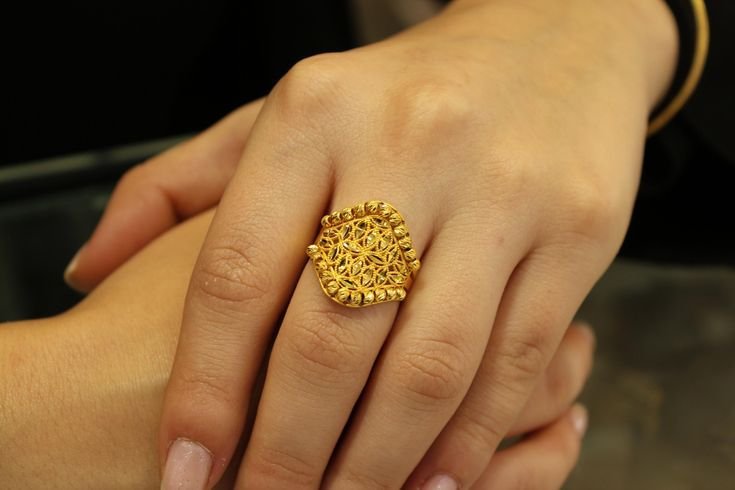
The Ring on Her Finger was Once a Dying Star
A Blog by Saurabh Aroraa
This is the True Story of how it got there
Somewhere on your body, or your mother’s, or folded into tissue paper in a drawer you haven’t opened in years, there is a small piece of metal older than the planet you are standing on.
Older than the oceans. Older than the first breath taken on Earth. Older than Earth itself. It is gold, and it did not begin here.
This is the story of how it arrived.
A Final Embrace
Long before our Sun, in a quiet corner of an older galaxy, there were two dead stars.
They had once burned with the ferocity that only the largest stars ever manage, blue and immense, the kind that make the rest of their galaxy look understated. But no star, however grand, burns forever. These two had already collapsed, their cores compressed into something the mind struggles to hold: neutron stars, each about twelve miles across, each so dense that a teaspoon of their matter would outweigh a mountain range.
For millions of years they circled one another, drawing closer by fractions of a millimetre each orbit, the way two lives sometimes do. Gravity, in the end, is patient. Time passed. The orbit tightened. And then, in a single instant, the dance ended.
The collision released more energy in one second than our Sun will release over its entire ten-billion-year lifetime. Space itself trembled; gravitational waves rolled outward through the fabric of the universe. A cloud of superheated matter, astronomers call it a kilonova, bloomed into the void.
“Gravity, in the end, is patient. Time passed. The orbit tightened. And then, in a single instant, the dance ended.”
Inside that bloom, something extraordinary was occurring. Atoms were being fed neutron after neutron, faster than they could absorb them, faster than nature ordinarily allows. New elements formed in the chaos, with elements too heavy for any ordinary star to produce. Platinum. Uranium.
And gold: not grams of it, nor kilograms, but quantities equal to several Earths, all born in the same luminous second.
The gold now on your finger was forged in that moment. Not mined, not grown, not drawn into being by any god of any myth. Made by the end of two stars that had, in their gravitational way, kept each other’s company for longer than most species have existed.
The Long Drift
The explosion that created the gold also sent it on its way. Tiny particles were flung outward at unimaginable speed, and then, as the initial violence faded, surrendered to a much slower motion: drift.
The journey lasted hundreds of millions of years. The gold passed dying stars and newborn ones. It drifted through nebulae whose colours we now photograph through telescopes. It moved through solar systems that formed, flowered, and disassembled while it travelled. It was, for a very long time, dust, stardust in the most literal sense, unclaimed, unobserved, unassigned to anything yet.
Then, in a quiet spiral arm of what would become our galaxy, a cloud of gas and cosmic debris began to gather. A small yellow star ignited at its centre, unremarkable by the standards of the universe. Around it, matter clumped into spheres. One of those spheres would, in time, be called Earth.
The gold arrived with the rubble.
Buried Alive
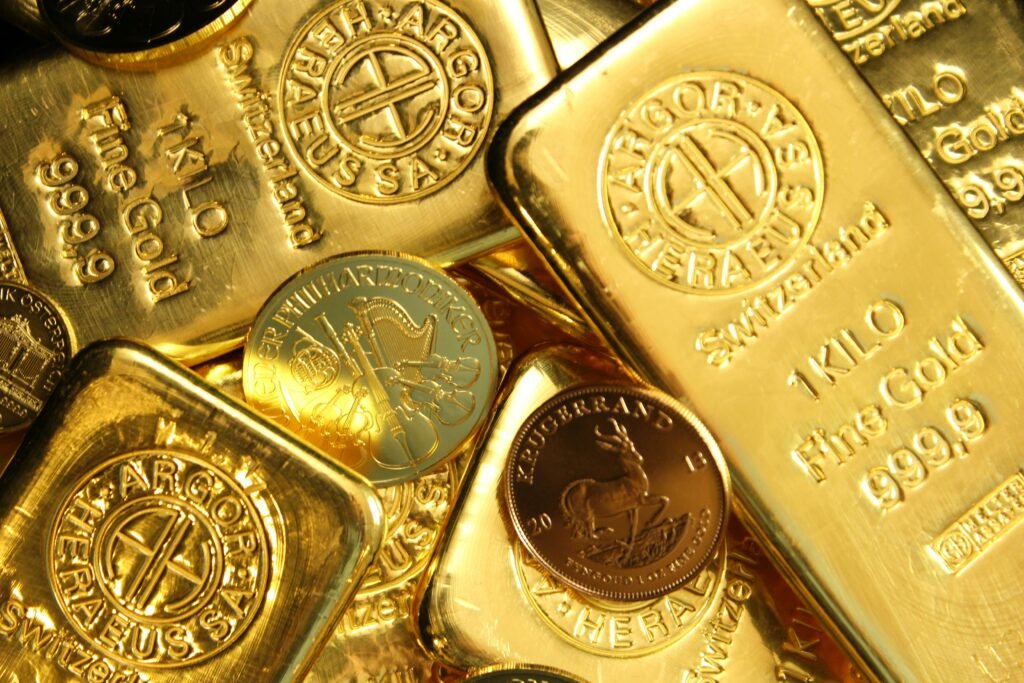
The young Earth was not the blue, composed world we know. It was molten. It was an ocean of glowing rock, releasing heat into space, still deciding what kind of planet it would be.
In that liquid environment, gold did what heavy things do. Denser than nearly everything around it, it sank. Down and down it went, through thousands of miles of fire, until it came to rest in the iron heart of the planet, far beyond any place a human being could ever stand. The gold that arrived with Earth’s birth is still there, locked in the core, and it will not return. Had the story ended at that first descent, we would never have held a single gram.
But the story did not end.
“The gold we know; the gold humans have held, hoarded, worn, came later. It came as violence.”
Roughly four billion years ago, Earth endured a bombardment unlike any it has known since. For several hundred million years, meteorites fell, some the size of small mountains, in numbers scientists now call the Late Heavy Bombardment. Each carried fragments of older cosmic events, stardust from collisions as violent as the one that had forged our gold. And this time, when the meteorites struck, Earth’s crust had cooled enough to hold them.
The gold settled near the surface, close enough that, billions of years later, something with hands and attention could find it. Every gram of gold that has ever been mined, cast, pressed, beaten, or threaded through fabric began its journey on Earth in that rain of stone.
The Patient Metal
Then the gold waited. While the first life stirred in the oceans; while fish learned to walk; while dinosaurs rose and vanished; while continents parted and mammals emerged and an upright primate began walking across the African plain—the gold waited, unchanged, beneath stone.
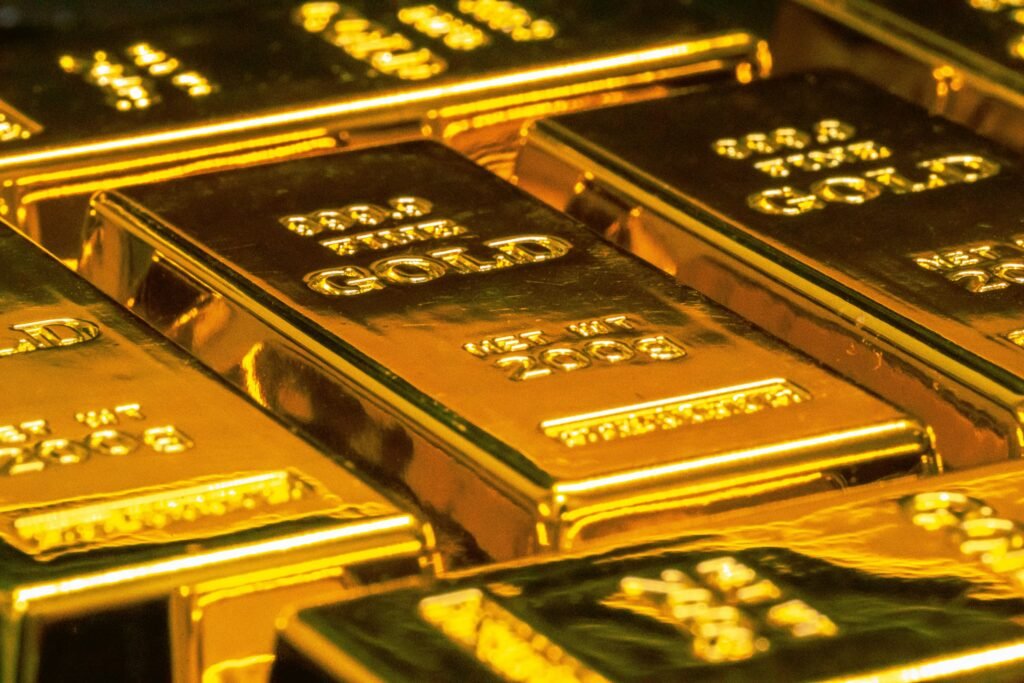
Volcanoes carried some of it upward through fractures in the Earth. Mineral-rich water left traces in veins of quartz. Rivers loosened it from rock, rolled it downstream, and polished it into nuggets that came to rest in gravel beds, catching the light whenever the water ran clear.
One day, someone noticed. We do not know who, or where, or in which century of the Pleistocene it happened. Only that a human being bent over a stream, saw a flicker that did not behave like anything else in nature, and reached in. What they pulled out did not rust, did not dull, did not tarnish. It caught the sun the way nothing else they had ever seen caught the sun.
They could not have known what they held. They only knew that it was beautiful, and that it would last.
Their instinct was correct. What they could not know was the rest: that the metal in their palm was the surviving echo of a cataclysm older than our solar system, a fragment of an event that had ended before there was anyone in the universe capable of being surprised by it.
The Ring
Now consider a ring.
Perhaps it is yours. Perhaps it belonged to a grandmother, passed from one set of hands to another until it arrived in your drawer with a faint perfume still clinging to the velvet. Perhaps it was chosen last month, lifted from a tray in a shop that smelled of new carpet and quiet money. It hardly matters.
Every atom in that ring was present at the death of two stars. Every atom survived a drift so long that whole galaxies were born and dissolved along the way. Every atom fell onto a molten Earth, endured four billion years of geology, and at last, improbably, came to rest on a human hand.
Yours, perhaps. Or someone you love.
The first people to shape gold believed it was divine, skin of the gods, metal of the sun. Empires later fought wars for it; kingdoms built their treasuries around it; goldsmiths in Constantinople, Kyoto, Lagos, and Jaipur refined, over centuries, the craft of making it beautiful. We have handed it to strangers at airports and to lovers at altars. We have pressed it into coins, threaded it through fabric, beaten it into leaf thinner than breath.
What we have rarely paused to consider is what it actually is.
It is a memory. A memory of a star already ancient when our Sun was young; of a collision we will never witness, in a place we will never visit; of an event that survived against every probability long enough to find its way onto a finger, a wrist, a throat.
The next time you catch the warm shine of it, across a dinner table, in a shop window, at the base of a beloved throat, remember that two stars ended so it could exist.
Two of them. In each other’s arms. A very long time ago.
And somehow, that light ended up here.
Every scientific detail in this essay is true. In 2017, astronomers directly observed a neutron-star collision GW170817 confirming that gold is indeed forged in such events. The rest is geology, history, and the strange grace of the universe in letting us hold a piece of it.








Beautifully written.
Never realized how much history and symbolism sits behind something as simple as a gold ring.
Thank you Pooja. Such well researched pieces always come with an element of awe and surprise.
Thank you, 🙂 and Yes Deepa. The awe lives in the editing as much as in the writing. Grateful to you, as always. 🙂
Thank you, Pooja. That’s exactly the feeling I hoped the piece would leave behind — the small shift of looking at something familiar and realising it has been carrying a much longer story all along. So glad it reached you.