















Holika Dahan in Phalain, Braj
Where Fire Mirrors the Soul
In a quiet Braj village, devotion is not remembered; it is enacted.
Each year, a priest walks through flame, and an ancient legend breathes again.
A Blog by Saurabh Aroraa
In the sacred landscape of Braj, where devotion is not preserved in memory but renewed through living ritual, festivals are not commemorations. They are transmissions.
In Phalain, a centuries-old village in the Mathura district of Uttar Pradesh, narrow lanes open into earthen courtyards, temple bells soften the twilight, and the Braj sky stretches wide and unadorned. On the eve of Holi, as dusk deepens into indigo and smoke begins to lace the air with sandalwood, the village gathers. Not in celebration, but in reverent expectancy.
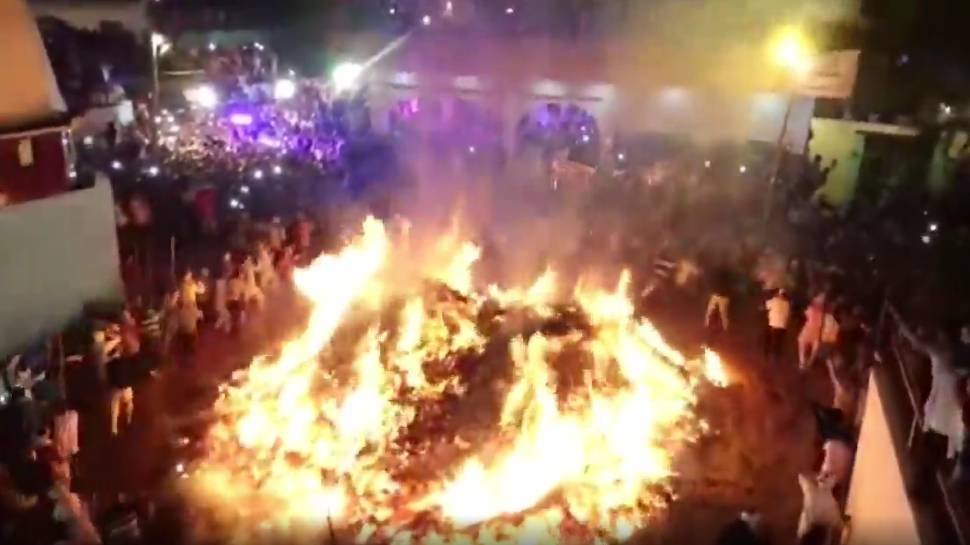
Across India, Holika Dahan marks the triumph of devotion over tyranny through ritual flame. In Phalain, the story does not remain symbolic. It is embodied.
Here, fire does not merely burn.
It tests. It witnesses. It reveals.
The Legend That Did Not Fade
The narrative is familiar. King Hiranyakashipu, intoxicated by power, demanded worship as a god. His young son Prahlad refused, surrendering instead to Vishnu. Enraged, the king sought to destroy him. Holika, Hiranyakashipu’s sister, confident in her supposed immunity to flame, seated herself with the little Prahlad upon a blazing pyre.
Divine order reversed human certainty.
Holika burned.
Prahlad did not.
Across the country, this episode is invoked in ritual fire. In Phalain, the village regards itself not as observer, but as inheritor of that sacred memory.
A Village Rooted in Sacred Continuity
Phalain is traditionally associated with Prahlad’s trial by fire. At its heart lies Prahlad Kund, a revered reservoir believed to mark the site where the child-devotee emerged unharmed. Nearby, the Prahlad Mandir preserves his murti and sacred mala, not as relics, but as living presences within the village’s devotional life.

The annual fire-walk, maintained through generations of the same priestly lineage, is said locally to have continued uninterrupted for centuries. Each year, the vow is renewed. Each year, the narrative re-enters time.
Unlike Barsana or Vrindavan, where Holi unfolds in radiant celebration, Phalain remains contemplative. Its devotion is not expressed in colour, but in elemental austerity.
The Discipline Before the Flame
What distinguishes Phalain is not spectacle, but sadhana.
For forty to forty-five days preceding Holika Dahan, the village priest, known locally as the Panda-Maharaja, undertakes a rigorous vrat (fast): brahmacharya, a satvik diet, pre-dawn japa, and daily immersion in the Prahlad narrative.
Speech is measured. Temper is guarded. Attention is refined.
The austerity is not personal asceticism alone; it is communal attunement. The villagers observe quietly, understanding that inner alignment must precede outward trial. In Phalain, the fire-walk begins long before the flame is kindled.
The Night the Flames Rise
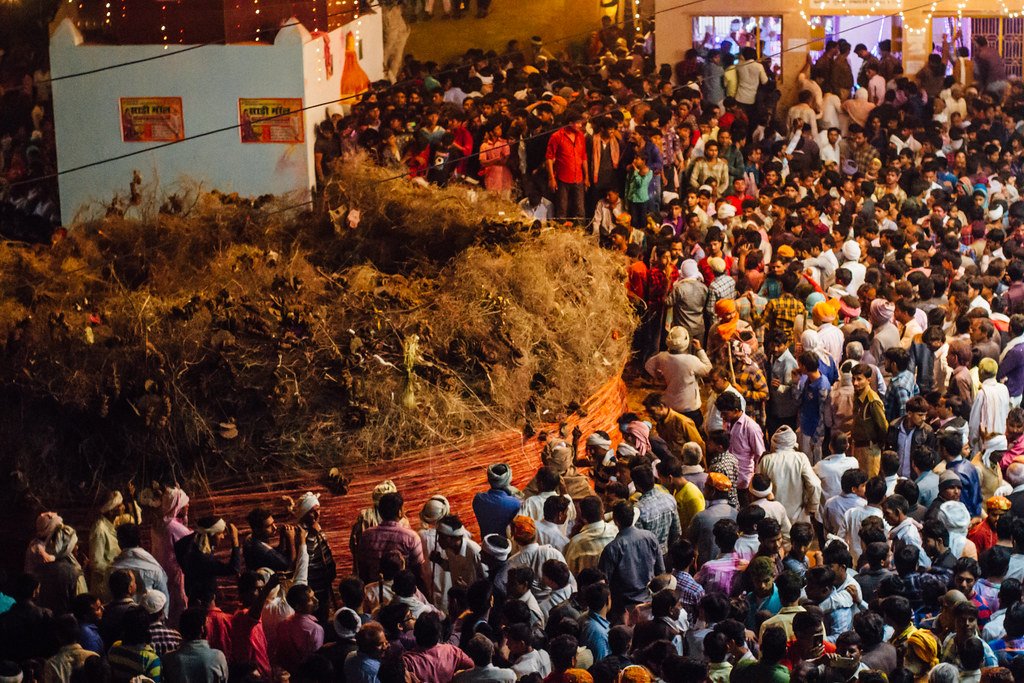
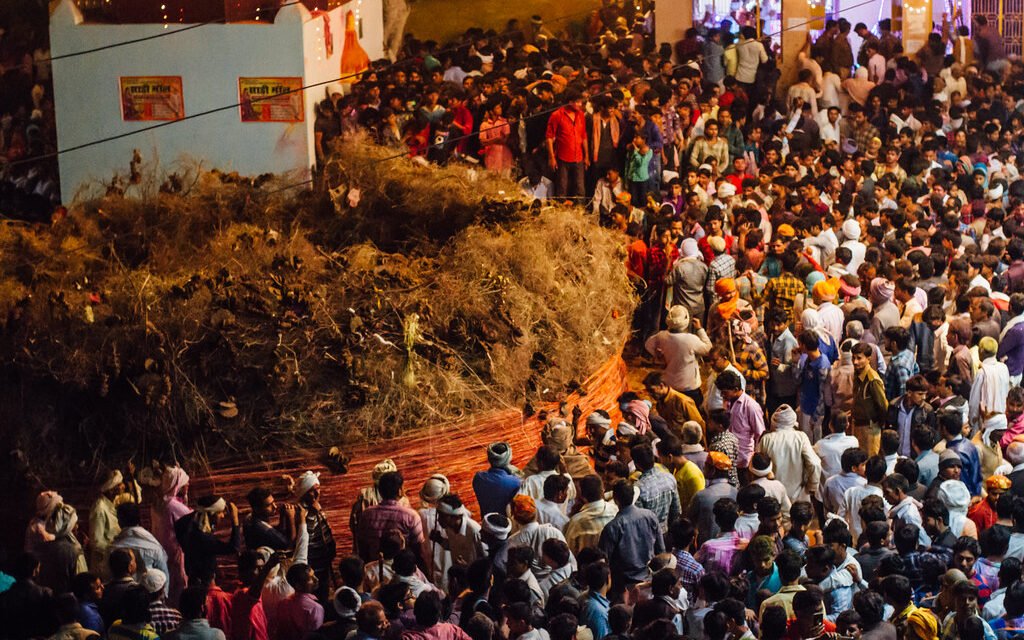
As darkness settles, the village square gathers into collective stillness. A towering pyre rises in concentric rings of timber wrapped in saffron cloth. At its centre rests Holika’s effigy. Less villain than turning point in a sacred account.
Before the flames are kindled, the priest bathes in Prahlad Kund. The immersion is not mere cleansing; it is entry into leela. Emerging clad in a simple yellow gamchha, he wears the sacred mala of Prahlad around his neck.
The crowd gathers; devotees arriving from across Braj and beyond. Drums begin their measured cadence. Conch shells pierce the evening air. The chant of “Narasimha Bhagavan ki Jai!” rises and falls like breath itself.
The pyre is lit.
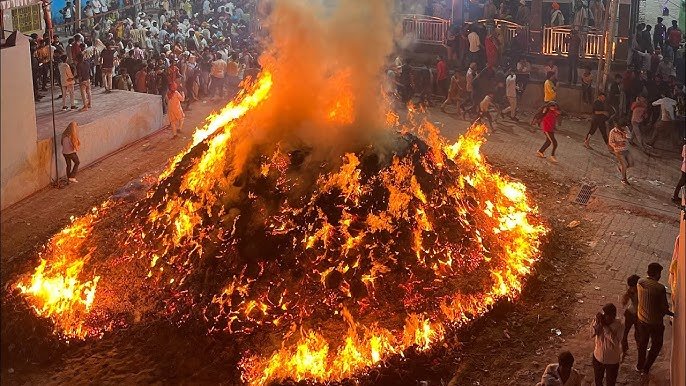
Heat presses outward in visible waves. Sparks scatter into the dark like errant stars.
Barefoot and unadorned, the priest steps forward. The yellow gamchha shifts lightly in the rising heat, the sacred mala at his throat catching the glow of flame.
There is no display. No drama. He enters the blaze and walks through the embers.
For a suspended moment, the flames surround him.
He emerges untouched.
The crowd does not erupt. It exhales.
Fire as Witness
In Vedic thought, Agni is not adversary but sacred witness. It sanctifies vows, receives offerings, and carries intention toward the unseen. In Phalain, that ancient understanding regains clarity.
Holika Dahan becomes less event than revelation.
As villagers circumambulate the pyre, they offer more than ritual grains. They offer pride. Resentment. Illusion. Fear.
What in us mirrors Hiranyakashipu’s arrogance?
What false refuge resembles Holika’s misplaced confidence?
What quiet steadfastness echoes Prahlad?
The flames illumine conscience.
When Fire Becomes Grace
For a world often measuring worth through accumulation, Phalain offers another measure: discipline as devotion, surrender as strength, remembrance as inheritance.
Holika Dahan here is not proof that a man can endure flame. It is a reminder that when faith aligns with dharma, even fire returns to its rightful place.
In the flicker of that annual blaze, beneath the wide Braj sky, the message endures with austere clarity:
Devotion does not burn.
Ego does.
About Saurabh Aroraa
Saurabh Arora is a dynamic professional with more than a two-decade career across hospitality, media, leadership training, and corporate strategy. His journey includes impactful roles with The Oberoi Group, The Taj Hotels, NDTV, Disney UTV, Times Network, and later, his own venture — Mediatel Communication International Pvt. Ltd., where he led global content localisation, business expansion, and international partnerships.
Spiritually transformed under the grace of Shri Radharaman Lal and Shrimati Radharani, and guided by His Holiness Shri Padmanabh Goswami Ji and Guru Maa Shrimati Saroj Goswami, Saurabh’s path deepened into Vedic sciences and soul-work.
Today, Based in the sacred land of Lord Krishna and Shrimati Radharani — Shri Vrindavan Dham, he is recognised for integrating Astrology, Numerology, Palm Reading, and Face Reading into a modern, practical framework. Offering 100% online consultations, he helps individuals understand karmic patterns and life purpose, inspiring youth and professionals to embrace spirituality as the foundation of clarity, balance, and authentic leadership.